
nylonppong
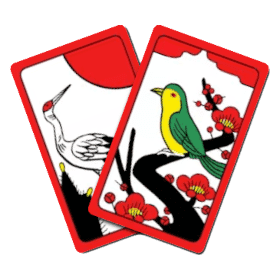 Nylon-ppong (or Nairong-ppong) is a Korean traditional Hwatu rummy game which combined some elements of Mahjong into other traditional games played with Tujeon.
Hwatu images by Marcus Richert and Hanafuda images by Louie Mantia Jr. are used under Free Art License 1.3, which is compatible with CC BY-SA 4.0 license.
Hwatu sound effects by JICA (Jeonju) are used under Korea Open Government License Type 1.
Nombre de jugadors: 2 - 6
Durada de la partida: 12 mn
Complexitat: 1 / 5
Juga a nylonppong i 1370 a altres jocs en línia.
No és necessari descarregar res - juga directament des del navegador web.
Amb les teves amistats i milers de jugadors del món sencer.
De franc.

Juga a nylonppong i 1370 a altres jocs en línia.
No és necessari descarregar res - juga directament des del navegador web.
Amb les teves amistats i milers de jugadors del món sencer.
De franc.
Resum de les regles
Nylon-ppong
Nylon-ppong (or Nairong-ppong) is a traditional Korean Hwatu rummy game for 2 to 6 players. It combines elements of Mahjong with traditional rummy mechanics.
Gameplay Flow
The game is played with a standard 48-card Hwatu deck (12 months, 4 cards each). Players must be familiar with the Korean month sequence (1 to 12) to calculate scores and sequences.
A round proceeds counterclockwise. On their turn, a player follows these steps:
- Draw: Draw one card from the face-down draw deck.
- Check: If the resulting 6 cards in hand form a valid combination, the player may end the round immediately.
- Discard: If no combination is formed, the player must discard one card to the pile to end their turn.
The round ends if the draw deck runs out of cards, a player "goes out" via a special action, or a player calls a 6-card combination.
Special Actions
Ppong (or Pong)
If a player holds two cards of the same month as the card just discarded to the top of the pile, they can call "Ppong".
- This can often be done out of turn.
- The player discards the matching pair from their hand.
- They must then discard one additional card to end their turn.
- If a player has no cards left after the final discard, they have gone out, and the round ends immediately.
Stop
A player who has only 2 cards remaining in their hand (after having called at least one "Ppong") can choose to call "Stop" instead of drawing a card.
- This is only allowed if the sum of the month numbers of their two cards is equal to or less than a predetermined limit (usually 5 or 10).
- Calling "Stop" ends the round immediately.
Combinations (6-Card Hands)
If a player ends the round by claiming one of these combinations, they ignore standard penalty points and instead receive the combination's value (which can be a negative number, reducing their total penalty score).
| Name | Value | Composition |
|---|---|---|
| Three pairs (Ddoi-ddoi) | 0 | Three pairs from three different months. |
| Two triplets (Ddoi-ddoi) | 0 | Two triplets from two different months. |
| Four and pair (Nejang-ddoi) | -50 | A four-of-a-kind and a pair of another month. |
| Straight | -Sum | 6 cards of consecutive months (e.g., months 3-8). |
| 10 or less (Sib-bujok) | -100 | 6 cards with a total sum of 10 or less. |
| 66 or more (Daeppang) | -100 | 6 cards with a total sum of 66 or more. |
Scoring and Penalties
At the end of a round, players typically receive penalty points equal to the sum of the month numbers of the cards remaining in their hand.
- Failed Stop: If a player calls "Stop" but another player has a lower (or equal) hand sum, the caller receives an additional 30 or 50 penalty points.
- Ppong Victim: If a player discards a card that allows another player to go out by calling "Ppong," the discarder receives an additional 30 or 50 penalty points.
- Starting Player: The player with the most penalty points from the previous round becomes the starting player for the next round.
Winning the Game
The game consists of a predetermined number of rounds. The player with the lowest total penalty points at the end is the winner.